ga_ma_2022 <- read_csv("../data/output/ma-snippets/ga-ma-data-2022.csv") %>%
  select(-partc_score) %>% ungroup()

ma_ratings <- read_csv("../data/output/ma-snippets/ga-ratings-2022.csv")

ga_ma_full <- ga_ma_2022 %>%
  left_join(ma_ratings, by="contractid") %>%
  mutate(raw_rating=rowMeans(
    cbind(breastcancer_screen, rectalcancer_screen, flu_vaccine,
          physical_monitor, specialneeds_manage, older_medication, older_pain,
          osteo_manage, diabetes_eye, diabetes_kidney, diabetes_bloodsugar,
          ra_manage, falling, bladder, medication, statin, nodelays,
          carequickly, customer_service, overallrating_care, overallrating_plan,
          coordination, complaints_plan, leave_plan, improve, appeals_timely,
          appeals_review, ttyt_available),
    na.rm=T)) %>%
    select(contractid, planid, fips, plan_type, partd, avg_enrollment, avg_eligibles,
           avg_enrolled, premium, premium_partc, premium_partd, rebate_partc, ma_rate,
bid, avg_ffscost, partc_score, partcd_score, raw_rating)More Medicare Advantage Data
Example: Star Ratings in 2022
import pandas as pd

# Read in data
ga_ma_2022 = (
    pd.read_csv("../data/output/ma-snippets/ga-ma-data-2022.csv")
    .drop(columns=["partc_score"], errors="ignore")
)

ma_ratings = pd.read_csv("../data/output/ma-snippets/ga-ratings-2022.csv")

# Merge on contractid
ga_ma_full = ga_ma_2022.merge(ma_ratings, on="contractid", how="left")

# Variables used to construct the raw rating
rating_vars = [
    "breastcancer_screen", "rectalcancer_screen", "flu_vaccine",
    "physical_monitor", "specialneeds_manage", "older_medication", "older_pain",
    "osteo_manage", "diabetes_eye", "diabetes_kidney", "diabetes_bloodsugar",
    "ra_manage", "falling", "bladder", "medication", "statin", "nodelays",
    "carequickly", "customer_service", "overallrating_care", "overallrating_plan",
    "coordination", "complaints_plan", "leave_plan", "improve", "appeals_timely",
    "appeals_review", "ttyt_available"
]

# Row-wise mean, ignoring missing values (na.rm = TRUE)
ga_ma_full["raw_rating"] = ga_ma_full[rating_vars].mean(axis=1, skipna=True)

# Keep the desired columns
ga_ma_full = ga_ma_full[
    [
        "contractid", "planid", "fips", "plan_type", "partd", "avg_enrollment",
        "avg_eligibles", "avg_enrolled", "premium", "premium_partc",
        "premium_partd", "rebate_partc", "ma_rate", "bid", "avg_ffscost",
        "partc_score", "partcd_score", "raw_rating"
    ]
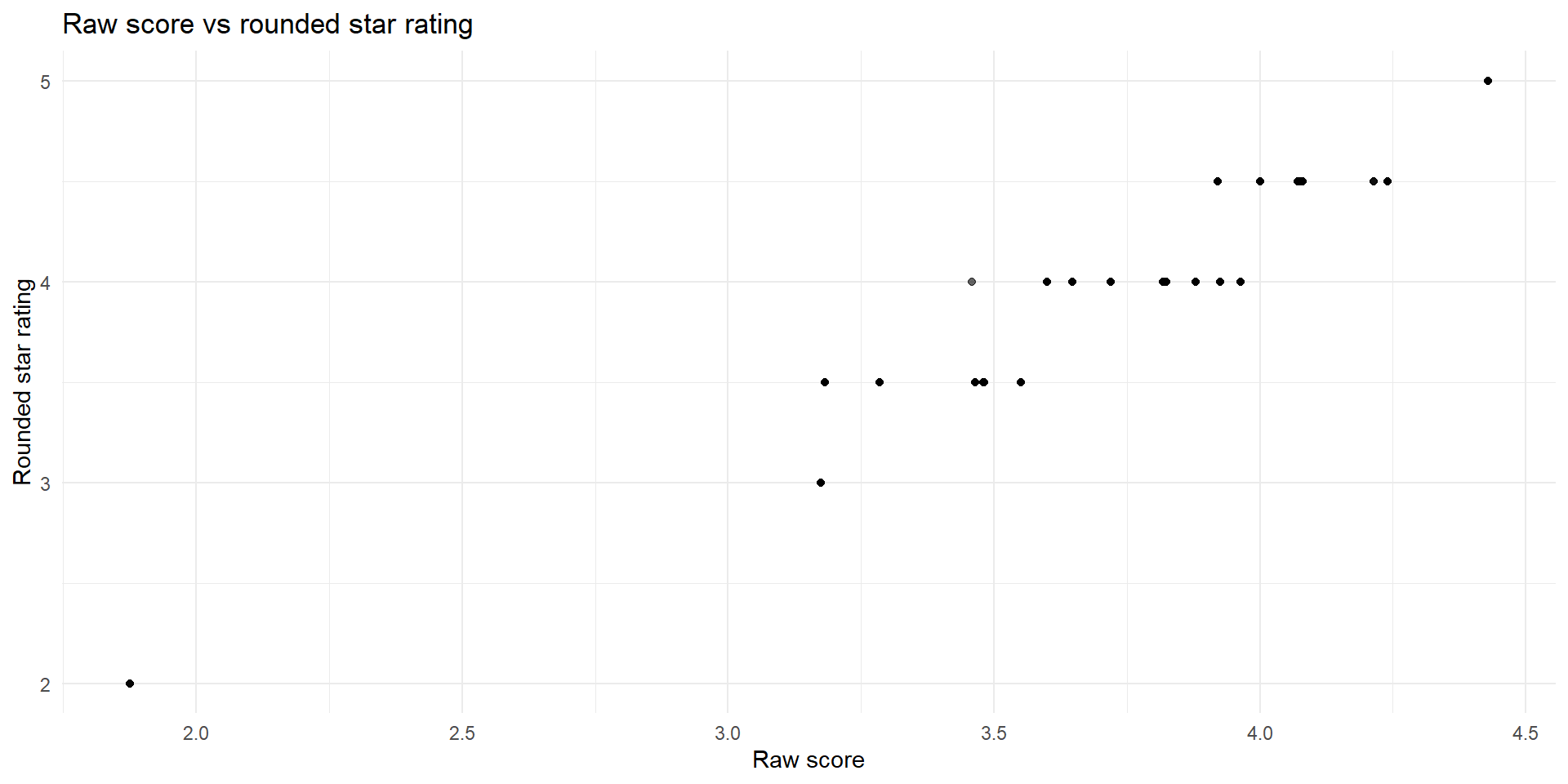
]
R Code
rounding_counts_3_75 <- ga_ma_full %>%
  filter(
    !is.na(raw_rating), !is.na(partc_score),
    partc_score %in% c(3.5, 4.0),
    raw_rating >= 3.5, raw_rating <= 4.0,
    (raw_rating >= 3.75 & partc_score==4.0) | (raw_rating <= 3.75 & partc_score==3.5)
  ) %>%
  mutate(
    `Raw Score` = if_else(raw_rating >= 3.75, "≥ 3.75", "< 3.75"),
    `Star`   = if_else(partc_score == 4.0, "4.0", "3.5")
  ) %>%
  count(`Raw Score`, `Star`, name = "Plans")

rounding_counts_3_75 %>%
  kbl(
    format  = "html",
    caption = "Ratings vs Raw Score"
  ) %>%
  kable_styling(
    bootstrap_options = c("striped", "hover", "condensed"),
    full_width        = FALSE,
    position          = "center"
)| Raw Score | Star | Plans |
|---|---|---|
| < 3.75 | 3.5 | 35 |
| ≥ 3.75 | 4.0 | 359 |
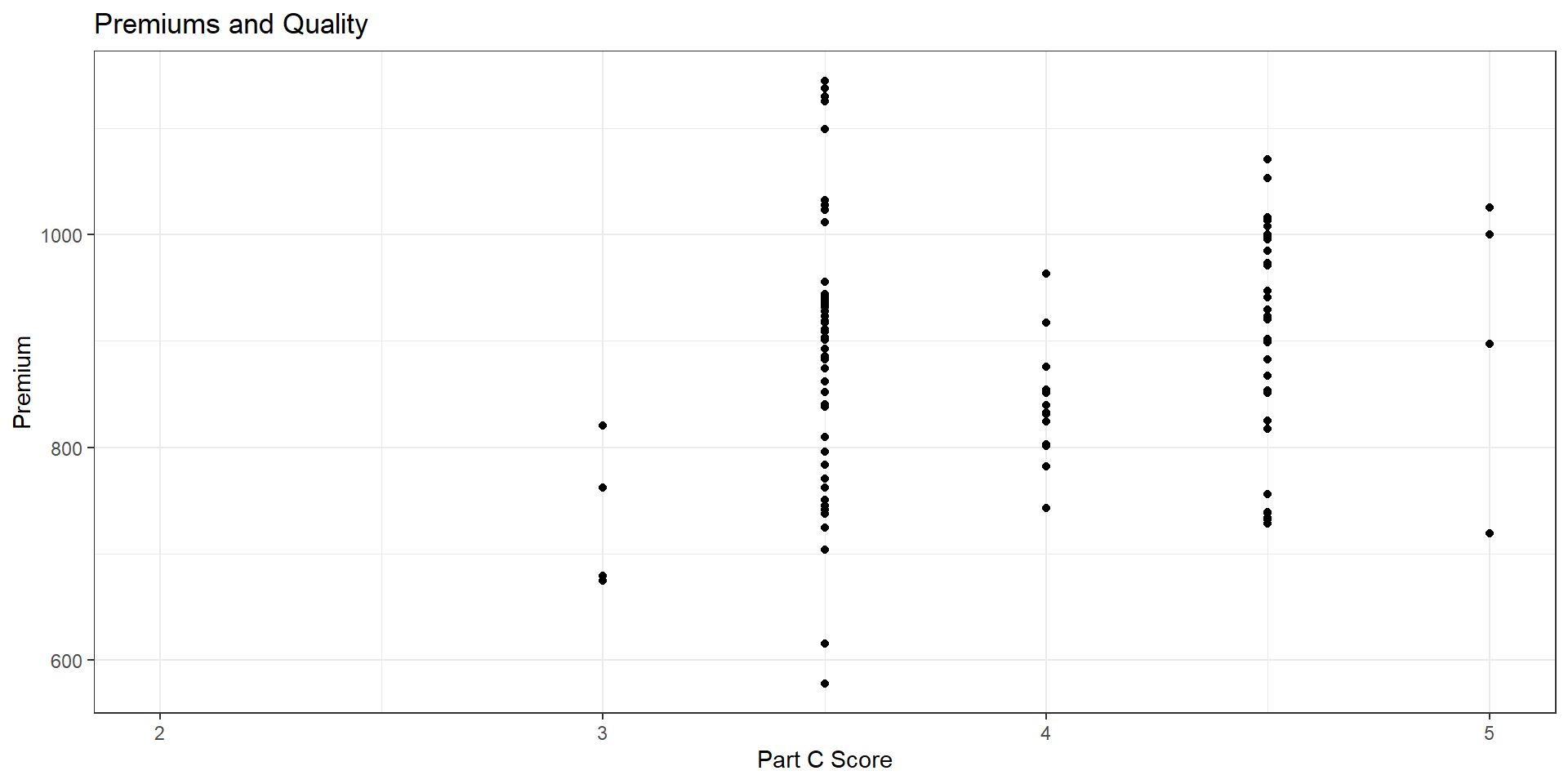
Potential endogeneity
- The star rating is a measure of quality
- Actual “quality” is not the same as “quality disclosure”
- Quality may be endogenous to enrollment (how?)
Call:
lm(formula = bid ~ factor(partc_score), data = ga_ma_full)

Residuals:
     Min       1Q   Median       3Q      Max
-261.079  -71.049    9.059   70.648  305.049

Coefficients:
                       Estimate Std. Error t value Pr(>|t|)
(Intercept)             750.240      6.714 111.739  < 2e-16 ***
factor(partc_score)3.5   89.295      7.392  12.079  < 2e-16 ***
factor(partc_score)4     80.448      7.853  10.244  < 2e-16 ***
factor(partc_score)4.5  181.633      7.284  24.936  < 2e-16 ***
factor(partc_score)5    119.729     17.831   6.715 2.21e-11 ***
---
Signif. codes:  0 '***' 0.001 '**' 0.01 '*' 0.05 '.' 0.1 ' ' 1

Residual standard error: 101.8 on 3272 degrees of freedom
  (7 observations deleted due to missingness)
Multiple R-squared:  0.2319,    Adjusted R-squared:  0.2309
F-statistic: 246.9 on 4 and 3272 DF,  p-value: < 2.2e-16