Instrumental Variables: Part I
Outline for Today
- Introduction to Instrumental Variables
- IV Assumptions
- IV with Simulated Data
- Interpreting IV Estimates
Introduction to Instrumental Variables
What is instrumental variables
Instrumental Variables (IV) is a way to identify causal effects using variation in treatment participation that is due to an exogenous variable that is only related to the outcome through treatment.
Why bother with IV?
Two reasons to consider IV:
- Selection on unobservables
- Reverse causation
Either problem is sometimes loosely referred to as endogeneity
Simple example
Consider simple regression equation: \[y = \beta x + \varepsilon (x),\] where \(\varepsilon(x)\) reflects the dependence between our observed variable and the error term.
Simple OLS will yield \[\frac{dy}{dx} = \beta + \frac{d\varepsilon}{dx} \neq \beta\]
What does IV do?
The regression we want to do, \[y_{i} = \alpha + \delta D_{i} + \gamma A_{i} + \epsilon_{i},\] where \(D_{i}\) is treatment (think of schooling for now) and \(A_{i}\) is something like ability.
\(A_{i}\) is unobserved, so instead we run \[y_{i} = \alpha + \beta D_{i} + \epsilon_{i}\]
From this “short” regression, we don’t actually estimate \(\delta\). Instead, we get an estimate of \[\beta = \delta + \lambda_{ds}\gamma \neq \delta,\] where \(\lambda_{ds}\) is the coefficient of a regression of \(A_{i}\) on \(D_{i}\).
Intuition
IV will recover the “long” regression without observing underlying ability
IF our IV satisfies all of the necessary assumptions.
More formally
We want to estimate \[E[Y_{i} | D_{i}=1] - E[Y_{i} | D_{i}=0]\]
With instrument \(Z_{i}\) that satisfies relevant assumptions, we can estimate this as \[E[Y_{i} | D_{i}=1] - E[Y_{i} | D_{i}=0] = \frac{E[Y_{i} | Z_{i}=1] - E[Y_{i} | Z_{i}=0]}{E[D_{i} | Z_{i}=1] - E[D_{i} | Z_{i}=0]}\]
In words, this is effect of the instrument on the outcome (“reduced form”) divided by the effect of the instrument on treatment (“first stage”)
Derivation
Recall “long” regression: \(Y=\alpha + \delta S + \gamma A + \epsilon\).
\[\begin{align} COV(Y,Z) & = E[YZ] - E[Y] E[Z] \\ & = E[(\alpha + \delta S + \gamma A + \epsilon)\times Z] - E[\alpha + \delta S + \gamma A + \epsilon]E[Z] \\ & = \alpha E[Z] + \delta E[SZ] + \gamma E[AZ] + E[\epsilon Z] \\ & \hspace{.2in} - \alpha E[Z] - \delta E[S]E[Z] - \gamma E[A] E[Z] - E[\epsilon]E[Z] \\ & = \delta (E[SZ] - E[S] E[Z]) + \gamma (E[AZ] - E[A] E[Z]) \\ & \hspace{.2in} + E[\epsilon Z] - E[\epsilon] E[Z] \\ & = \delta C(S,Z) + \gamma C(A,Z) + C(\epsilon, Z) \end{align}\]
Derivation
Working from \(COV(Y,Z) = \delta COV(S,Z) + \gamma COV(A,Z) + COV(\epsilon,Z)\), we find
\[\delta = \frac{COV(Y,Z)}{COV(S,Z)}\]
if \(COV(A,Z)=COV(\epsilon, Z)=0\)
IVs in practice
Easy to think of in terms of randomized controlled trial…
| Measure | Offered Seat | Not Offered Seat | Difference |
|---|---|---|---|
| Score | -0.003 | -0.358 | 0.355 |
| % Enrolled | 0.787 | 0.046 | 0.741 |
| Effect | 0.48 |
Angrist et al., 2012. “Who Benefits from KIPP?” Journal of Policy Analysis and Management.
What is IV really doing
Think of IV as two-steps:
- Isolate variation due to the instrument only (not due to endogenous stuff)
- Estimate effect on outcome using only this source of variation
In regression terms
Interested in estimating \(\delta\) from \(y_{i} = \alpha + \beta x_{i} + \delta D_{i} + \varepsilon_{i}\), but \(D_{i}\) is endogenous (no pure “selection on observables”).
Step 1: With instrument \(Z_{i}\), we can regress \(D_{i}\) on \(Z_{i}\) and \(x_{i}\): \[D_{i} = \lambda + \theta Z_{i} + \kappa x_{i} + \nu,\] and form prediction \(\hat{D}_{i}\).
Step 2: Regress \(y_{i}\) on \(x_{i}\) and \(\hat{D}_{i}\): \[y_{i} = \alpha + \beta x_{i} + \delta \hat{D}_{i} + \xi_{i}\]
Derivation
Recall our first-stage, \(S=\theta Z + \varepsilon\), where \(\hat{\theta}=\frac{C(Z,S)}{V(Z)}\), or \(\hat{\theta}V(Z) = C(Z,S)\). Then:
\[\begin{align} \hat{\delta} & = \frac{COV(Y,Z)}{COV(S,Z)} \\ & = \frac{\hat{\theta}C(Y,Z)}{\hat{\theta}C(S,Z)} = \frac{\hat{\theta}C(Y,Z)}{\hat{\theta}^{2}V(Z)} \\ & = \frac{C(\hat{\theta}Z,Y)}{V(\hat{\theta}Z)} = \frac{C(\hat{S},Y)}{V(\hat{S})} \end{align}\]
Animation for IV
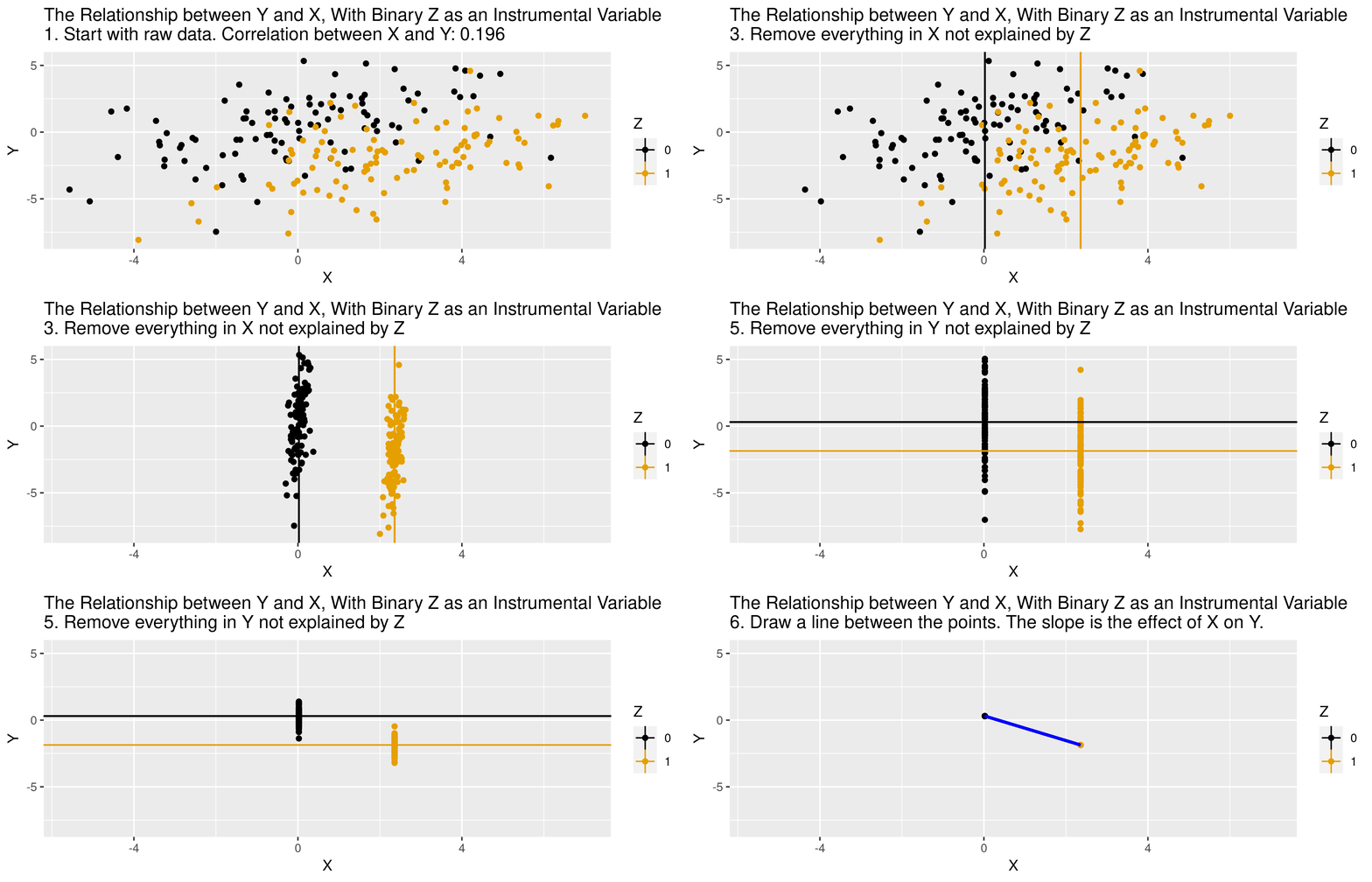
In regression terms
But in practice, DON’T do this in two steps. Why?
Because standard errors are wrong…not accounting for noise in prediction, \(\hat{D}_{i}\). The appropriate fix is built into most modern stats programs.
Formal IV Assumptions
Key assumptions
- Exclusion: Instrument is uncorrelated with the error term
- Relevance: Instrument is correlated with the endogenous variable
- Monotonicity: Treatment more (less) likely for those with higher (lower) values of the instrument
Assumptions 1 and 2 sometimes grouped into an only through condition or discussed as instrument validity
Exclusion Assumption
- Not directly testable
- Often relies on context and specific policy details
Failure of Exclusion
Conley et al (2010) and “plausible exogeneity”, union of confidence intervals approach
- Suppose extent of violation is known in \(y_{i} = \beta x_{i} + \gamma z_{i} + \varepsilon_{i}\), so that \(\gamma = \gamma_{0}\)
- IV/TSLS applied to \(y_{i} - \gamma_{0}z_{i} = \beta x_{i} + \varepsilon_{i}\) works
- With \(\gamma_{0}\) unknown…do this a bunch of times!
- Pick \(\gamma=\gamma^{b}\) for \(b=1,...,B\)
- Obtain \((1-\alpha)\) % confidence interval for \(\beta\), denoted \(CI^{b}(1-\alpha)\)
- Compute final CI as the union of all \(CI^{b}\)
Failure of Exclusion
Kippersluis and Rietveld (2018), “Beyond Plausibly Exogenous”
- “zero-first-stage” test
- Focus on subsample for which your instrument is not correlated with the endogenous variable of interest
- Regress the outcome on all covariates and the instruments among this subsample
- Coefficient on the instruments captures any potential direct effect of the instruments on the outcome (since the correlation with the endogenous variable is 0 by assumption).
Relevance
Just says that your instrument is correlated with the endogenous variable, but what about the strength of the correlation?

Relevance and Instrument “Strength”
Recall our schooling and wages equation, \[y = \beta S + \epsilon.\] Bias in IV can be represented as:
\[Bias_{IV} \approx \frac{Cov(S, \epsilon)}{V(S)} \frac{1}{F+1} = Bias_{OLS} \frac{1}{F+1}\]
- Bias in IV may be close to OLS, depending on instrument strength
- Bigger problem: Bias could be bigger than OLS if exclusion restriction not fully satisfied
Testing strength of instruments
Single endogenous variable
- Stock & Yogo (2005) test based on first-stage F-stat (homoskedasticity only)
- Critical values in tables, based on number of instruments
- Rule-of-thumb of 10 with single instrument (higher with more instruments)
- Lee et al (2022): With first-stage F-stat of 10, standard “95% confidence interval” for second stage is really an 85% confidence interval
- Over-reliance on “rules of thumb”, as seen in Anders and Kasy (2019)
Testing strength of instruments
Single endogenous variable
- Stock & Yogo (2005) test based on first-stage F-stat (homoskedasticity only)
- Kleibergen & Paap (2007) Wald statistic
- Effective F-statistic from Olea & Pflueger (2013)
Testing strength of instruments: First-stage
Single endogenous variable
- Homoskedasticity
- Stock & Yogo, effective F-stat
- Heteroskedasticity
- Effective F-stat
Many endogenous variables
- Homoskedasticity
- Stock & Yogo with Cragg & Donald statistic, Sanderson & Windmeijer (2016), effective F-stat
- Heteroskedasticity
- Kleibergen & Paap Wald is robust analog of Cragg & Donald statistic, effective F-stat
Summary of Instrument Strength
- Test first-stage using effective F-stat (inference is harder and beyond this class)
- Many endogenous variables problematic because strength of instruments for one variable need not imply strength of instruments for others
IV with Simulated Data
Simulated data
- endogenous
eps: affects treatment and outcome zis an instrument: affects treatment but no direct effect on outcome
OLS and IV Estimates
Recall that the true treatment effect is 5.25
import numpy as np
import pandas as pd

# --- data ---
n = 5000
b_true = 5.25
rng = np.random.default_rng(123)  # for reproducibility

iv_dat = pd.DataFrame({
    "z":   rng.normal(0, 2, n),
    "eps": rng.normal(0, 1, n),
})

iv_dat["d"] = (
    iv_dat["z"] + 1.5 * iv_dat["eps"] + rng.normal(0, 1, n) > 0.25
).astype(int)

iv_dat["y"] = 2.5 + b_true * iv_dat["d"] + iv_dat["eps"] + rng.normal(0, 0.5, n)

# --- OLS: lm(y ~ d) ---
import statsmodels.formula.api as smf

ols = smf.ols("y ~ d", data=iv_dat).fit()
print(ols.summary())

# --- IV/2SLS: feols(y ~ 1 | d ~ z) ---
# (y on intercept, endogenous d, instrument z)
try:
    from linearmodels.iv import IV2SLS

    iv = IV2SLS.from_formula("y ~ 1 + [d ~ z]", data=iv_dat).fit(cov_type="robust")
    print(iv.summary)
except ImportError:
    # Fallback: manual 2SLS using statsmodels
    import statsmodels.api as sm

    first = sm.OLS(iv_dat["d"], sm.add_constant(iv_dat["z"])).fit()
    iv_dat["d_hat"] = first.fittedvalues
    second = sm.OLS(iv_dat["y"], sm.add_constant(iv_dat["d_hat"])).fit()

    print("\nFirst stage (d ~ z):")
    print(first.summary())
    print("\nSecond stage (y ~ d_hat):")
    print(second.summary())
Call:
lm(formula = y ~ d, data = iv.dat)

Residuals:
    Min      1Q  Median      3Q     Max
-3.5988 -0.7071  0.0141  0.6875  3.9679

Coefficients:
            Estimate Std. Error t value Pr(>|t|)
(Intercept)  2.09456    0.01995   105.0   <2e-16 ***
dTRUE        6.13007    0.02925   209.6   <2e-16 ***
---
Signif. codes:  0 '***' 0.001 '**' 0.01 '*' 0.05 '.' 0.1 ' ' 1

Residual standard error: 1.032 on 4998 degrees of freedom
Multiple R-squared:  0.8978,    Adjusted R-squared:  0.8978
F-statistic: 4.392e+04 on 1 and 4998 DF,  p-value: < 2.2e-16
TSLS estimation - Dep. Var.: y
Endo. : d
Instr. : z
Second stage: Dep. Var.: y
Observations: 5,000
Standard-errors: IID
Estimate Std. Error t value Pr(>|t|)
(Intercept) 2.50530 0.029548 84.7877 < 2.2e-16 ***
fit_dTRUE 5.24675 0.053608 97.8716 < 2.2e-16 ***
---
Signif. codes: 0 '***' 0.001 '**' 0.01 '*' 0.05 '.' 0.1 ' ' 1
RMSE: 1.12156 Adj. R2: 0.231381
F-test (1st stage), dTRUE: stat = 2,715.24, p < 2.2e-16, on 1 and 4,998 DoF.
Wu-Hausman: stat = 549.86, p < 2.2e-16, on 1 and 4,997 DoF.Logical Diagnostic: The “Reduced Form”
- “Reduced form” means the conditional relationship between the outcome and the instrument (in practice, just replacing the endogenous variable with the instrument in a regression)
- While not an official statistical test, empirical researchers often look to the “reduced form” as a reasonableness check of the IV design
- A zero (or wrong-signed) reduced form casts doubt on either relevance or exclusion, but does not tell you which
- A nonzero and properly signed reduced form is necessary for a meaningful IV estimand but provides no validation of exclusion or exogeneity
Call:
lm(formula = y ~ z, data = iv.dat)

Residuals:
    Min      1Q  Median      3Q     Max
-8.0911 -2.1728 -0.0365  2.1631  9.1191

Coefficients:
            Estimate Std. Error t value Pr(>|t|)
(Intercept)  4.94776    0.04001  123.66   <2e-16 ***
z            0.77845    0.02006   38.81   <2e-16 ***
---
Signif. codes:  0 '***' 0.001 '**' 0.01 '*' 0.05 '.' 0.1 ' ' 1

Residual standard error: 2.829 on 4998 degrees of freedom
Multiple R-squared:  0.2315,    Adjusted R-squared:  0.2314
F-statistic:  1506 on 1 and 4998 DF,  p-value: < 2.2e-16
Instrument Relevance: First Stage
Call:
lm(formula = d ~ z, data = iv.dat)

Residuals:
     Min       1Q   Median       3Q      Max
-1.03085 -0.32969 -0.01796  0.33273  1.11780

Coefficients:
            Estimate Std. Error t value Pr(>|t|)
(Intercept) 0.465519   0.005679   81.97   <2e-16 ***
z           0.148368   0.002847   52.11   <2e-16 ***
---
Signif. codes:  0 '***' 0.001 '**' 0.01 '*' 0.05 '.' 0.1 ' ' 1

Residual standard error: 0.4016 on 4998 degrees of freedom
Multiple R-squared:  0.352, Adjusted R-squared:  0.3519
F-statistic:  2715 on 1 and 4998 DF,  p-value: < 2.2e-16
Two-stage equivalence
Call:
lm(formula = y ~ d.hat, data = iv.dat)

Residuals:
    Min      1Q  Median      3Q     Max
-8.0911 -2.1728 -0.0365  2.1631  9.1191

Coefficients:
            Estimate Std. Error t value Pr(>|t|)
(Intercept)  2.50530    0.07452   33.62   <2e-16 ***
d.hat        5.24675    0.13521   38.81   <2e-16 ***
---
Signif. codes:  0 '***' 0.001 '**' 0.01 '*' 0.05 '.' 0.1 ' ' 1

Residual standard error: 2.829 on 4998 degrees of freedom
Multiple R-squared:  0.2315,    Adjusted R-squared:  0.2314
F-statistic:  1506 on 1 and 4998 DF,  p-value: < 2.2e-16
Interpretation
Heterogenous TEs
- In constant treatment effects, \(Y_{i}(1) - Y_{i}(0) = \delta_{i} = \delta, \text{ } \forall i\)
- Heterogeneous effects, \(\delta_{i} \neq \delta\)
- With IV, what parameter did we just estimate? Need monotonicity assumption to answer this
Monotonicity
Assumption: Denote the effect of our instrument on treatment by \(\pi_{1i}\). Monotonicity states that \(\pi_{1i} \geq 0\) or \(\pi_{1i} \leq 0, \text{ } \forall i\).
- Allows for \(\pi_{1i}=0\) (no effect on treatment for some people)
- All those affected by the instrument are affected in the same “direction”
- With heterogeneous ATE and monotonicity assumption, IV provides a “Local Average Treatment Effect” (LATE)
LATE and IV Interpretation
- LATE is the effect of treatment among those affected by the instrument (compliers only).
- Recall original Wald estimator:
\[\delta_{IV} = \frac{E[Y_{i} | Z_{i}=1] - E[Y_{i} | Z_{i}=0]}{E[D_{i} | Z_{i}=1] - E[D_{i} | Z_{i}=0]}=E[Y_{i}(1) - Y_{i}(0) | \text{complier}]\]
- Practically, monotonicity assumes there are no defiers and restricts us to learning only about compliers
Is LATE meaningful?
- Learn about average treatment effect for compliers
- Different estimates for different compliers
- IV based on merit scholarships
- IV based on financial aid
- Same compliers? Probably not
LATE with defiers
- In presence of defiers, IV estimates a weighted difference between effect on compliers and defiers (in general)
- LATE can be restored if subgroup of compliers accounts for the same percentage as defiers and has same LATE
- Offsetting behavior of compliers and defiers, so that remaining compliers dictate LATE